|
|

I Love ASTROBLEMES!
(Impact Craters)
| Peekskill Meteorite | ||

|
||
| (1993). MPEG (996 Kbytes) | ||
Sky & Telescope's Impact Hazards Web Site - Internet Impact
provides a list of links to sites on the web that will keep you entertained for hours. Astronomy Online article by Stu Goldman
###
For more information on the NEO threat see:
NASA Asteroid and Comet Impact Hazard Web-Site
NASA Asteroid Impact Image Gallery
NASA NEO Program Office Web-Site at JPL
UK Government NEO Information Centre
From: baalke@jpl.nasa.gov
7/31/02 2:11 PM
Subject: 60 Million-Year-Old Crater Mapped In North Sea
60m-year-old meteor crater mapped in North Sea
Ananova
July 31, 2002
Scientists have mapped a small but well-preserved crater in the North
Sea formed by a meteorite they believe smacked into Earth 60 to 65
million years ago.
The impact crater measures about six miles wide and sits beneath 120
feet of seawater and more than 900 feet of sediment.
Researchers believe the so-called Silverpit crater was formed after the
catastrophic impact near Mexico's Yucatan Peninsula that scientists
suspect contributed to the extinction of the dinosaurs.
"We know so little about how impact structures are created when
meteorites and comets hit," said University of New Brunswick geologist
John G. Spray, who reviewed the crater data for the journal Nature,
which published details in its current issue. "Any new example helps."
Full story here:
http://www.ananova.com/news/story/sm_641050.html
~~~~~~~~~~~~~~~~~~~~~~~~~~~~~~~~~~~~~~~~~~~~~~~~~~~~~~~~~~~~~~~~~~~~
FROM THE MINOR PLANET MAILING LIST [date]. For the full text or to subscribe, please visit:
MPML Home page: http://www.bitnik.com/mp
MPML FAQ: http://www.bitnik.com/mp/MPML-FAQ.html
MPML's Yahoogroups page: http://www.yahoogroups.com/group/mpml
------------------------------------------------------------------------
Earth's Oldest Known Impact
After combing through ancient marine sediments in South Africa and Western
Australia, geologists have discovered evidence for four globe-rattling
impacts that occurred between 3.2 and 3.5 billion years ago. Gary R.
Byerly (Louisiana State University, Baton Rouge) and three colleagues have
not found the craters themselves, which likely have been obliterated over
the eons, but rather the "smoking guns" represented by layers of small
spherules that were blasted from each target zone and subsequently rained
out of the sky over wide regions. The oldest layer, which Byerly's team
pegs at 3.470 ± 0.002 billion years old, contains shocked grains of the
mineral zircon, as well as an abundance of the element iridium (which is
relatively common in meteorites) roughly 10 times higher than that in
typical crustal rocks. The thickness and wide distribution of the spherule
layers suggest each blast was 10 to 100 times more powerful than one 65
million years ago that formed a 180-kilometer-wide crater now buried
beneath Mexico's Yucatán Peninsula. Only about 160 confirmed impact sites
are known on Earth; the previous record-holder for age, at 2 billion
years, is the 300-km-wide Vredefort crater in South Africa.
http://SkyandTelescope.com/news/current/article_722_1.asp
For more information on the NEO threat see:
NASA Asteroid and Comet Impact Hazard Web-Site
NASA Asteroid Impact Image Gallery
NASA NEO Program Office Web-Site at JPL
Click on the new U.S. Geological Survey (USGS) Learning Web at http://www.usgs.gov/education/index.html to try your hand at exploring the world of natural science. The site has a new look with an enhanced search capability and special areas designed specifically for students in grades K-12, teachers, and "explorers" (everyone else).
Students will find handy research tools, such as glossaries covering volcanoes, mapping, biology, and water; they can do searches for assistance with school project ideas and find help with homework.
Teachers and homeschoolers will find lesson plans with innovative activities regarding environmental concerns, fossils, caves, and much more.
"Explorers" can look into areas of special interest to them, such as understanding natural hazards, investigating careers in science, and tracing history through maps.
The USGS serves the nation by providing reliable scientific information to describe and understand the Earth; minimize loss of life and property from natural disasters; manage water, biological, energy, and mineral resources; and enhance and protect our quality of life.
The Impact of an Asteroid off the New York Coast
Animation from Sandia National Laboratory.
Comet Images from Sandia.
The Solar System Visualization Project from JPL has developed new visualization/animation techniques, algorithms, and technologies for planetary science applications including earth-crossing asteroids.
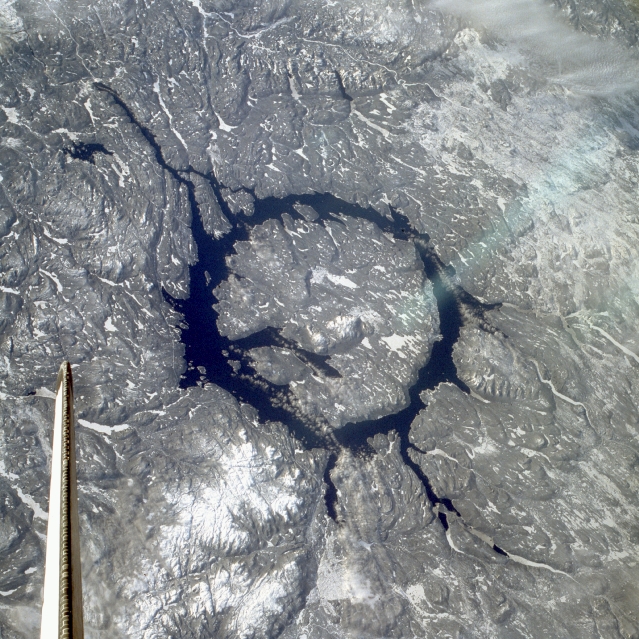
The Manicouagan Crater in northern Canada is one of the oldest impact craters known
Manicouagan, CA / Meteor Crater, AZ
More Asteroids
Astronomical
Headlines
Sources of Remote sensing Software
 Anatomy of a Torn Comet
| New Stuff / Friends / Astronomy |